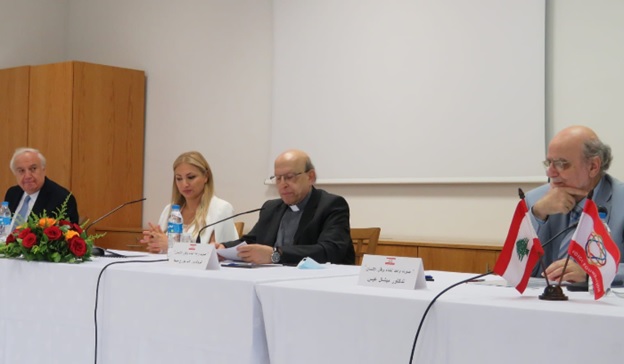
Seminar: “One Voice for Building the Nation of Humanity” The One Voice Foundation organized a seminar entitled “One Voice for Building the Nation of Humanity”, featuring interventions from the Honorary President of the Holy Spirit University of Kaslik, Father Professor Georges Hobeika, Dr. Michel Abs, and Dr. Paul Jalwan. The seminar was moderated by lawyer and journalist Roula Elia. The seminar, held at Our Lady of the Well Monastery in Qanayya, began with a speech by the Foundation’s President, Kalaydjian, in which he recalled the historical equation proclaimed by Saint Pope John Paul II “Lebanon is a message and more than a homeland.” He stressed that “The mission of the Foundation is centered on contributing to the protection of Lebanon’s identity of freedom, human rights, justice, and the model of shared living; achieving responsible citizenship and the rule of law to safeguard all citizens through the promotion of democratic dialogue; ensuring the continuity of the Christian presence in the East and constructive Islamic–Christian communication; highlighting the unique pluralistic Eastern social model; creating a meeting space between different segments of Levantine society to address the challenges they face and seek solutions; and supporting the work of other associations, leagues, and parties so that the institution becomes a sustainable platform and an integral part of all the components of Lebanon, the Levant, and the diaspora.” He continued: “Our voice is one, united, in the service of the public good and truth, wherever they may be, to serve the free, responsible, and upright democratic citizen. We have dedicated ourselves to a cohesive national charter that defines our noble principles, goals, and honorable means, safeguarded by our unique human character and distinct qualities. Our voice is one in the struggle for a homeland of the message — the message of humanity in Lebanon and throughout this beloved Levant, where we are all children of God, united in love and equality.” He thanked “the speakers for their profound insights in this time of heightened emotions and emptiness imposed by the pains of the moment.” Father Hobeika The first intervention came from Father Hobeika, who said: He went on to draw a parallel with the myth of Sisyphus condemned to eternally push a boulder uphill only for it to roll back down as an image of Lebanon’s cyclical struggle. Quoting Albert Camus’s interpretation, he emphasized that awareness of the absurd should not lead to despair but to defiant acceptance, resisting fate through perseverance. Father Hobeika reflected on Lebanon’s history of repeated rebuilding efforts from the founding of Greater Lebanon in 1920, through the prosperity of the 1960s under President Fouad Chehab, to the political decay after the civil war and the Taif Agreement, when the state’s institutions fell into the hands of warlords, militias, and political parties. He lamented the disappearance of a generation of selfless statesmen Chehab, Elias Sarkis, Camille Chamoun, Raymond Edde, Riad El Solh, Abdallah El Yafi, and others whose integrity and service stood in stark contrast to the corruption of today. He concluded: “We may be condemned to push Lebanon’s rock up the steep mountain over and over, but we will persist with legendary determination until we break the Sisyphus cycle and anchor Lebanon forever at the summit — as a homeland for humanity.” Dr. Abs Dr. Abs spoke about “the historical and political foundations that shaped the current form of the Antiochian Levant, and the conspiracies intertwined with these foundations that led to making it a region stripped of stability and resistant to development.” He addressed the structural and existential crises afflicting the region, their consequences in migration and decline, and outlined the role of the Middle East Council of Churches, which he serves as Secretary General, stressing that all their work is rooted in Christian values and in the teachings and actions of the incarnate Lord. Dr. Jalwan Dr. Jelwan discussed “an educational charter for establishing Lebanon as the Nation of Humanity, in its strategic, pedagogical, and educational dimensions, and the urgent educational measures that must be implemented to revive Lebanon.” He emphasized that “the only stable and sustainable solution lies in an advanced educational reform plan based on freedom and democracy, in line with the Universal Declaration of Human Rights, to achieve a genuine and effective consociational democracy that guarantees positive outcomes for the nation.”
|