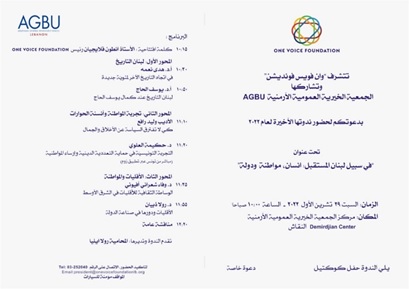
Seminar: “For the sake of Lebanon’s future: a person, a citizen and a state”
The event was attended by MP Neemat Frem, Bishop Antoine Abou Najem, Fawaz Kabbara representing the Minister of Culture in the caretaker government, Mohammad Wissam Al-Mortada, Dr. Abdel Raouf Sinno (former president of Maqasid University), former minister Youssef Salame, and Imad Khayyat, director of Al Mayadeen’s Beirut office, representing Ghassan Ben Jeddou. Also present were the Secretary-General of Catholic Schools, Father Youssef Nasr, as well as a committee of poets, writers, politicians, religious leaders, and intellectuals from various fields including doctors, lawyers, engineers, and businesspeople. The seminar also included participation from the Kamal Youssef El-Hage Chair for Lebanese Philosophy, Adyan Foundation, ORA Union, Lebanese Foundation for Citizenship, Lebanese Green Party, Lebanon Dialogue Initiative, Friends of the Lebanese University, Rahbe Tajmaa Association, Sada Al-Salam Association, Elias Mokheiber Foundation, Baldati, and Rethinking Lebanon. Kalaydjian The meeting then opened with a speech by the President of the One Voice Foundation, Antoine Kalaydjian, who welcomed the audience, considering the gathering “a unifying national tradition and the culmination of a series of sessions and seminars dedicated to various aspects of national life. We believe that citizenship, if not built by its people, remains a burden on them for generations to come.” He added: “We have strived to transform the phrase ‘Lebanon is a message, greater than a homeland’ which politics had emptied of meaning into a reality of living together with rationality, wisdom, and openness. We promise to be one voice calling for a dignified life for every person in this homeland, and to struggle for the homeland of the message, in Lebanon and throughout this beloved Levant, where we are all children of God in love and equality. We will be One Voice for Building the Nation of Humanity, by which we mean the voice of every suffering person, every rebel against tyrants who exploit the pain of the Lebanese, in defense of the oppressed against all injustice.” Presentations
Al-Haj Other Interventions In the second session, writer Walid Rafea said: “Politics is the capacity of ethics to lead people, the art of guiding them toward a better, ever-developing reality that seeks the sovereignty of awareness, responsible freedom, happiness, and the dignity of existence. When it governed people, politics was among the noblest of professions, akin to the work of prophets and great philosophers, leading humanity to goodness and renewal moving from the narrow ‘I’ toward the expansive ‘We,’ where the other becomes a constant concern for both mind and soul, and where separate egos vanish in favor of the singular, creative, human political conscience.” Also in this session, Dr. Hakima Alawi from Tunisia spoke via Zoom, stating: “Coexistence is a human necessity before being a practical one, and the need for it grows with the presence of religious, intellectual, and cultural diversity in a single society. In support of this perspective, we present Tunisia’s experience in protecting religious diversity to ensure a sound concept of citizenship beginning with the ‘Pact of Security’ (Ahd Al-Aman), the first constitution in Tunisian, Arab, and Islamic history, followed by the post-independence constitution, and finally the post-revolution constitution.” Third Session Dr. Wafa Shaarani Afyouni said: “Humanity is not merely composed of nation-states, social classes, and ideological currents. Before all else, it is a mosaic of nations, cultures, and religions, the product of accumulated civilizations that shape both our conscious and unconscious selves. Observing reality requires examining the essential components of societies. With the resurgence of religion and ethnic identity in global politics, particularly in the complex geopolitics of the Middle East we must reconsider the role of culture in public life to prevent the erosion of sub-identities and their forced assimilation into ideological molds that ignore culture’s role in shaping history. Today’s Arab region is rife with conflicts, each fueled by latent seeds of difference. We must reject the concept of ‘minorities’ as it signals a crisis in socio-cultural security. We are communities in one of the oldest and richest cultural regions of the world, and we must halt our decline by renewing the relationship between society and culture through enlightenment and internal renewal.” Dr. Roula Zoubiane spoke on the role of minorities in state-building, covering:
The event concluded with an open discussion and a cocktail reception.
|